Diriyah, Qiddiya, Red Sea: Which Giga-Projects Are Still Moving and Why It Matters for Suppliers
In October 2025, Knight Frank published its annual Saudi Arabia Giga Projects report. The value of contracts awarded by Saudi Arabia's giga-projects reached $196 billion, a 20% increase year-on-year, as the Kingdom accelerated development across real estate, infrastructure, and tourism. Arab News That number tells part of the story. The more useful question for a European company evaluating where to position is not the aggregate total, but which projects are actively awarding contracts, which have recalibrated, and what the distinction means for suppliers and service providers trying to find their entry point.
16 March 2026
Which Giga-Projects Are Still Moving and Why It Matters for Suppliers
In October 2025, Knight Frank published its annual Saudi Arabia Giga Projects report. The value of contracts awarded by Saudi Arabia's giga-projects reached $196 billion, a 20% increase year-on-year, as the Kingdom accelerated development across real estate, infrastructure, and tourism. Arab News That number tells part of the story. The more useful question for a European company evaluating where to position is not the aggregate total, but which projects are actively awarding contracts, which have recalibrated, and what the distinction means for suppliers and service providers trying to find their entry point.
The answer in early 2026 is more differentiated than headline figures suggest.
The Recalibration That Changed the Landscape
The context for reading any giga-project data in 2026 is the PIF's spending adjustment. Contract awards accelerated in 2024, surpassing $30 billion as delivery gathered pace across major Vision 2030 developments. In 2025, awards moderated to approximately $13.8 billion, compared to $29.5 billion the previous year. This is not a halt. It is a recalibration. Lower oil revenues and tighter fiscal conditions have prompted a strategic review of timelines, scope, and capital allocation, with priority shifting towards projects capable of delivering near-term economic impact. MEED
That single sentence, near-term economic impact, is the key to understanding which projects are moving fastest and why. Projects that generate revenue quickly, that can demonstrate proof of concept through initial operations, and that are anchored to fixed deadlines like Expo 2030 and FIFA 2034 are receiving protected capital. Projects built around a longer-dated vision are being phased.
The practical effect is that Diriyah and Qiddiya, both Riyadh-based, event-anchored, and revenue-generating in their initial phases, are among the most active construction environments in the kingdom right now. The Red Sea project is operating differently.
Diriyah: The Most Active Contract Environment
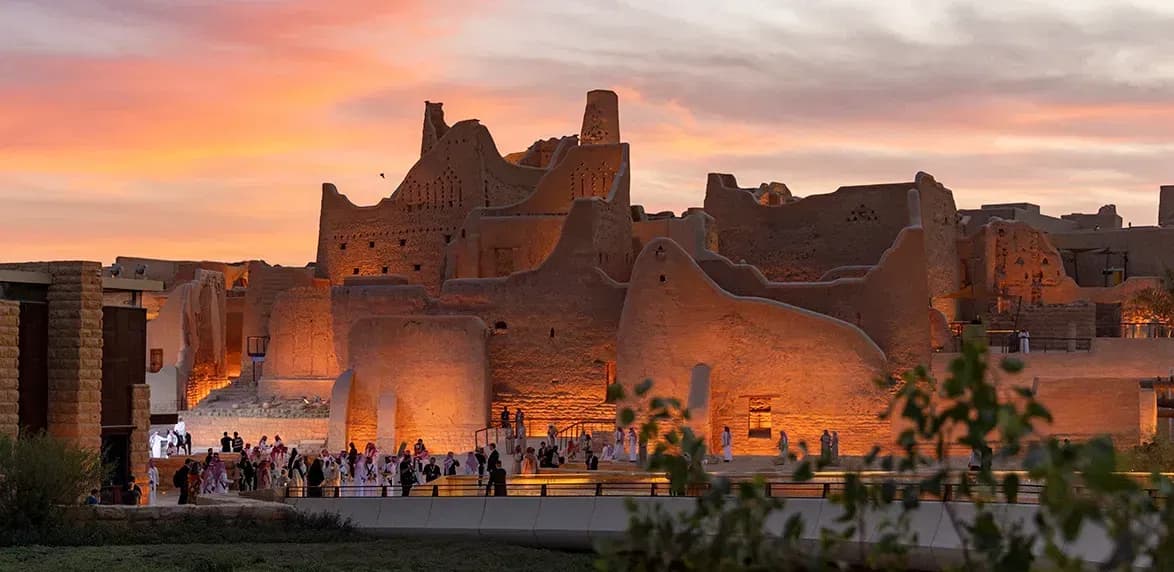
Diriyah is the clearest example of a giga-project that has successfully de-risked itself through phased delivery. Diriyah has accelerated its development in the past year, with more than $27 billion of contracts awarded since the beginning of 2024. More than $5 billion of tenders were awarded in the first half of 2025 alone. AGBI
The scale of what is under construction is significant. In the first half of 2025, the total value of awarded contracts reached SAR 18.75 billion across 15 major agreements. Among the most significant were a SAR 5.1 billion contract for the Royal Diriyah Opera House, a SAR 4.225 billion contract for utilities relocation within the masterplan, and a SAR 2.249 billion contract for the Diriyah Square retail precinct. Diriyahcompany
The project is also delivering revenue today, which changes its risk profile entirely. Diriyah welcomed more than 3.6 million visits by mid-2025 and continues to advance toward its goal of attracting 50 million annual visits by 2030. Its emphasis on phased delivery, most notably the early openings of At Turaif and Bujairi Terrace, which have generated revenue quickly, contrasts with front-loaded development strategies and has mitigated risk, generated momentum, and provided tangible proof of concept. AGBI
The total value of commissioned projects at Diriyah stands at $14.5 billion, with $45.6 billion more in the pipeline. Arab News That pipeline represents the forward opportunity. The Royal Diriyah Opera House, Diriyah Arena, Diriyah Square, 40 planned hotels across the masterplan, and the broader residential and cultural districts are all at various stages of design, procurement, and construction. For European companies in architecture, hospitality fit-out, cultural institution management, luxury retail, F&B, landscape design, acoustic engineering, or specialist construction services, Diriyah represents an active and well-funded pipeline that extends well beyond 2026.
Qiddiya: Delivering on Entertainment, Building Toward Sport
Qiddiya opened its first major asset on 31 December 2025. Six Flags Qiddiya City, the first Six Flags theme park outside North America, opened to the public on New Year's Eve, featuring 28 rides and attractions including Falcons Flight, the world's tallest, fastest, and longest roller coaster. Blooloop That opening matters not just as a milestone, but as a signal that the project is executing, that international operators are committing, and that the entertainment capital concept has moved from masterplan to operating reality.
The contract pipeline behind that opening illustrates the depth of the opportunity. The main construction contract for Six Flags Qiddiya City, valued at around SAR 3.75 billion, was awarded to a joint venture between Bouygues Bâtiment International and Saudi contractor Almabani General Contractors. Contractors and specialist suppliers installed 28 rides and attractions, themed architecture across six distinct lands, and the retail and F&B spaces that complete the guest experience. Cbnme
The next wave of contracts is already in motion. Construction of the 45,000-seat Prince Mohammed bin Salman Stadium, set to be one of the host venues for the FIFA World Cup 2034, has started. In October 2025, Saudi company Nesma & Partners won the contract to build the Qiddiya Performing Arts Centre. AGBI Aquarabia, the water park that forms the second major attraction at Qiddiya City, is also advancing toward a 2026 opening.
The FIFA 2034 deadline creates a structural procurement urgency around Qiddiya that mirrors the dynamic at Diriyah. The stadium and surrounding infrastructure cannot be deferred. That makes the sports and transport contracts that flow from Qiddiya's second phase relatively predictable in timing, which is exactly the kind of forward visibility European engineering and construction companies need to plan their Saudi market positioning.
The Red Sea: A More Selective Opportunity
The Red Sea project tells a different story, and it is important to read it accurately.
Saudi Arabia is revising its ambitious Red Sea tourism strategy, scaling back plans to build 81 luxury resorts by 2030. Red Sea Global denied plans to downsize, saying the project would continue after the initial phase of 27 resorts is completed in 2026. But sources with knowledge of the plans said construction would halt at the end of 2026. Daily Sabah
The operating context explains the reassessment. Phase One of the Red Sea project produced ten resorts. One consultant described occupancy rates as "mostly sitting empty," noting that high pricing and the enormous scale of the projects was a problem, with demand significantly overestimated. Daily Sabah
RSG itself describes the situation differently, citing strong commercial and operational performance, the hiring of over 3,000 employees in 2025, and a stated commitment to Phase Two delivery through a sequenced approach. Red Sea Global secured a $3.76 billion term green loan and revolving credit facility from four Saudi banks in May 2025, providing external financing that reduces reliance on PIF capital. AGBI
What is clear is that the Red Sea project is entering a more measured phase. Phase One construction, airport operations, and the first resorts on Shura Island are proceeding. Phase Two expansion, the broader archipelago development, and the original target of 50 resorts by 2030 are under active review. For suppliers and service providers, the opportunity in the near term is concentrated on completing Phase One assets and the operational infrastructure that serves them, not on the speculative pipeline of Phase Two construction.
What the Differentiation Means for Suppliers
The giga-project landscape in 2026 is not uniform, and treating it as such is the fastest way to misdirect a market entry strategy.
Diriyah is the most consistently active construction environment across the broadest range of sectors. Cultural institutions, hospitality, luxury retail, urban infrastructure, and residential development are all proceeding simultaneously with large, named contracts. The project's proximity to Riyadh, its integration with the existing city fabric, and its non-negotiable cultural heritage mandate mean it commands a level of government commitment that is unlikely to soften.
Qiddiya is building toward a hard deadline in 2034 and generating its own revenue from 2026 onward. The sports, entertainment, and performance arts pipeline is real, funded, and on a timeline that cannot be extended without consequence. The convergence of FIFA, Six Flags, and the planned Formula One circuit creates a procurement environment that runs through the decade.
The Red Sea remains significant but requires more selective entry. Companies already embedded in Phase One supply chains are well-positioned. Companies looking to enter through Phase Two construction contracts are operating in a less certain environment until the scope review resolves.
By 2030, giga-project development in western Saudi Arabia is expected to deliver more than 382,500 new homes, over 3 million square metres of office space, 4.3 million square metres of retail space, and 330,000 hotel rooms. Arab News Those numbers represent demand across every sector of construction, design, fit-out, technology, and operations. The question for any European company is not whether the opportunity is real. It is whether they have positioned themselves inside the procurement relationships before the contracts are awarded, because by the time tenders are public, the competitive field is already established.
Saudi Venture Hub is based in Riyadh. We work with European companies navigating Saudi market entry, from legal structure and compliance to the relationships and presence that turn a licence into a business. If you want to understand what genuine commitment to this market looks like in practice, we are available for that conversation.